

Extreme Caving in Namibia
Where no man has gone before...
Every cave explorer's dream... to venture somewhere no human has ever been before. To discover and explore new territories. This is admittedly quite difficult; the white spots on our maps are getting smaller and smaller, people have even been to the moon - and that was before I was born.
But it is possible; there are still many unknown areas in the deep sea - however, states and scientific institutes research here with considerable financial investment.
But there are still areas on our Earth waiting to be discovered, well, not directly on the Earth but underneath it. That was a reason for me to first become a dry cave climber and decades later a cave diver.
After 2.5 years of preparation, the time finally came in June 2024. After an 11-hour flight and another 8 hours of travel, our team arrived at Harasib Farm to dive in the legendary Dragon's Breath Cave (Drachenhauchloch Höhle).

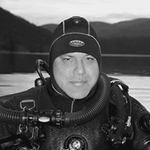
Our team, (from left to right): Oliver Schöll, Stefan Gries, Ralf Wupper, Alan Calovs, Tom Baier, Markus Schuster, Chris Steenkamp, Louw Greff, Stefan Pape
Dragon's Breath Cave is located in northern Namibia in the Otvai Mountains, and within the cave lies the world's largest underwater lake, covering 2.6 hectares. The water surface is approximately 60 meters below ground, depending on the water level. The deepest dive was undertaken in 2015 to a depth of 132 meters. After the 3D survey by Stone Aerospace's Sunfish dive robot from Texas in 2019, the maximum depth was measured at 205 meters.
Click here for the Sunfish dive robot's 3D map.

Photo: Dragon's Breath 3D Map © Stone Aerospace
The biggest logistical and physical challenge for us was the descent and ascent, and especially the transport of about 1.8 tons of material. The path from the cave entrance doesn't go straight down; instead, all material first has to be transported through a bottleneck only about 50cm wide, and then lowered via 3 more transfer points directly onto pre-roped boats and swimming platforms directly onto the water surface. All of this was known to us, which is why such an expedition is not undertaken lightly. For us, Scapehander, a good team of experienced cave divers is important. We don't want push-dives by individual divers. Everyone in the team is equally important, and everyone should reach their goal. It was therefore necessary to safely lower a total of 10 rebreathers, 22 bailout stages, and of course bright lights from Eraunderwater and the camera equipment of Oliver Schöll and Stefan Pape for the 8 divers.

Photo: Louw Greff (Loki) abseiling equipment at the "Bridge" transfer point, platforms on the water can be seen below ©Oliver Schöll

Photo: Arranging equipment for transport to the water surface
But let's start at the beginning; first, the dive plan has to be in place. We planned for a maximum depth of 200 meters and a maximum dive time of 10 hours. We had already been to Dragon's Breath the previous year and abseiled down to the water's surface to better plan the logistics. Here's a short video of our preparation. We also practiced abseiling, donning equipment, and setting up the diving gear on the swimming platform in the pool. Here's a short video of that:
After extensive preparation, dive planning, material planning, and logistical planning, we were able to carry out our dive on June 17, 2024. Thanks to good preparation and accurate training, it went almost perfectly. We reached a depth of 157 meters in the system and were able to surface, exhausted but happy, after a 9-hour dive. Here's a short trailer of our dive:
After the dive, we rested on the chilly platforms for about 6 hours and then began our ascent. The sunrise over the Namibian steppe was an uplifting sight after days in the darkness.
The press and media response was swift; the Allgemeine Zeitung from Windhoek was the first to report on our dive:

Then a large tourism portal in Namibia joined in:
Click here for the article from namibian.org magazine!
Then we were guests on HR television, where we were allowed to talk about Namibia on the show "Hallo Hessen":
Click here for the broadcast in the ARD Mediathek!

The Hessenschau also reported in advance about our training in the Schwalefeld mine:
Click here for the TV report in the ARD Mediathek!
Then the Giessener Anzeiger also reported:
What happens next...
I have been accompanying our preparations and of course the dive for 3 years, and next winter I will create a documentary film that summarizes everything, includes interviews with the divers, and provides insight into the implementation of such a large project.